
Chorus Kansas City
Voices of the Soul
Program notes
Introduction to Sacred Harp and Shape-Note Singing
The first three pieces of the concert today are arrangements inspired by Sacred Harp singing. This tradition of sacred music developed in New England and perpetuated in the American southern states. The name is derived from The Sacred Harp, a historically important Shape-note tune book printed in 1844. Sacred Harp singing has roots over the period of 1770 to 1820 in and around New England, under the influence of "revival" services and resulting singing schools. This music was included in, and became profoundly associated with books using the shape-note style of notation popular in America in the late 18th and early 19th centuries.
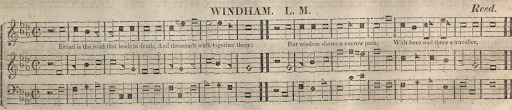
The Virginia Harmony is a shape-note tune book published in 1831 which included the three hymn tunes you will hear today, “Windham”, “Idumea” and “Harmony Grove” (the hymn tune of “Amazing Grace”).
From The Virginia Harmony, page 69:
Click on a song title to jump to that section.
Chorus Kansas City
Kansas City Chamber Singers
Lawrence High School Choir
Chorus Kansas City
Combined Chorus Kansas City and Lawrence High School Choir
Windham, by Daniel Read, text by Isaac Watts
In our first selection, the 18th Century hymn tune “Windham” by Daniel Read, is paired with Isaac Watts' 1709 text “The Almost Christian, the Hypocrite, and Apostate”. The first line, ‘Broad, is the road that leads to death’, and the rest of the hymn suggests that many paths in life lead to negative outcomes or moral decay and contrasts with the idea of a "narrow path" that leads to life, emphasizing the difficulty of choosing righteousness.
Isaac Watts (1674 -1748) was an English Congregational minister, hymn writer, theologian, and logician. He was a prolific and popular hymn writer and is credited with some 750 hymns. His works include "When I Survey the Wondrous Cross", "Joy to the World", and "O God, Our Help in Ages Past". He is recognized as the "Godfather of English Hymnody"; many of his hymns remain in use today and have been translated into numerous languages.
Daniel Read (1757 - 1837) was an American composer and a primary figure in early American classical music. He was one of the “Yankee Tunesmiths” (1st New England School of Music) when classical music was popular in Europe. Read was a private in the Massachusetts militia and later a comb maker and owner of a general store in New Haven, CN. He was only the 3rd composer in the U. S. to put out a collection of his own music in the 18th Century.
Broad is the road that leads to death,
And thousands walk together there;
But wisdom shows a narrow path,
With here and there a traveler.
Deny thyself and take thy cross,
Is the Redeemer's great command:
Nature must count her gold but dross,
If she would gain that heav'nly land.
The fearful soul that tires and faints,
And walks the ways of God no more,
Is but esteemed almost a saint,
And makes his own destruction sure.
Lord, let not all my hopes be vain,
Create my heart entirely new,
Which hypocrites could ne'er attain,
Which false apostates never knew.
Idumea, Composed by Ananias Davisson, arranged by Richard Bjella, Text by Charles Wesley
The hymn tune “Idumea” was written by Ananias Davisson (1780-1857) in 1816. Written in Shenandoah County, Virginia, “Idumea” is one of the most haunting and popular Appalachian songs in Southern shape-note collections. This piece, set by Richard Bjella, pairs “Idumea” with Charles Wesley’s hymn text “And am I born to die” written in 1753. Wesley was an 18th century English hymn writer, poet, and preacher who wrote over 5,500 hymns and was the leader of the Methodist movement with his brother John Wesley.
Richard Bjella has distinguished himself as an internationally-acclaimed conductor, clinician, choral pedagogue, and choral arranger. In 2014, Bjella was appointed Artistic Director of the San Antonio Chamber Choir. He retired from Texas Tech University in 2017, but previous to his work in Lubbock, Bjella served 25 years as Director of Choral Studies at the Lawrence Conservatory of Music. Choirs under his leadership have performed on numerous occasions for the American Choral Directors Association and the Texas Music Educators Association.
And am I born to die?
To lay this body down?
And must my trembling spirit fly
Into a world unknown?
A land of deepest shade,
unpierced by human thought,
The dreary regions of the dead,
Where all things are forgot?
Soon as from earth I go,
What will become of me?
Eternal happiness or woe
Must then my portion be:
Waked by the trumpet’s sound,
I from my grave shall rise,
And see the Judge, with glory crowned,
And see the flaming skies!
Choral Reflection on Amazing Grace, arranged by Roger Ames, Text by John Newton
The hymn tune we recognize as “Amazing Grace” was initially known as “Harmony Grove” and later as “New Britain”. One of the earliest known print sources of the tune “Harmony Grove” is found in The Virginia Harmony. In 1847 this tune was paired with John Newton’s lyrics of “Amazing Grace”, the Hymn tune was renamed “New Britain” and was published in Southern Harmony. This ancient hymn tune has its earliest roots in Scotland.
The lyrics of “Amazing Grace” first appeared in Olney Hymns (1779) and the text reflects Newton’s intense religious conversion experience while serving as the Captain of a slave trade ship. He believed it was only the grace of God that saved a wretch like him from death during a violent storm in the Atlantic.
Roger Ames (1944–2022) was born in Cooperstown, New York. He studied composition with Samual Barber, John Kander, Lukas Foss, Robert Washburn, and others, and has degrees from the Crane School of Music, SUNY Potsdam, and the Aaron Copland School of Music, Queens College.
Ames wrote numerous large works, both sacred and secular. His fascination with American folk music and his love for choral music inspired him to write many folk song arrangements. In this arrangement Ames pairs “Amazing Grace” with the Kyrie from the Latin Mass text, Kyrie eleison, Christe eleison, Kyrie eleison (Lord, have mercy; Christ, have mercy; Lord have mercy). “A Choral Reflection on Amazing Grace” was commissioned and premiered in 2002 by Dr. James Jordan and the Williamson Singers of Westminster Choir College and has been performed by many choirs since then.
Amazing grace (how sweet the sound)
that saved a wretch like me!
I once was lost, but now am found,
was blind, but now I see.
Through many dangers, toils and snares
I have already come:
'tis grace has brought me safe thus far,
and grace will lead me home.
'Twas grace that taught my heart to fear,
and grace my fears relieved;
how precious did that grace appear
the hour I first believed!
When we’ve been there ten thousand years,
Bright shing as the sun,
We’ve no less days to sing God’s praise
Than when we’d first begun
The Lord has promised good to me,
his word my hope secures;
he will my shield and portion be
as long as life endures.
Measure Me, Sky! Composed by Jonathan Reid, Text by Leonora Speyer (1872-1956)
Jonathan Reid’s setting of “Measure Me, Sky!” is a breathtaking contemporary choral work that captures the essence of limitless ambition and the human spirit’s desire to expand beyond its physical boundaries. While many composers have set Leonora Speyer’s 1921 poem to music, Reid’s interpretation is lauded for its driving energy, lush harmonic language, and rhythmic vitality.
The piece serves as a soaring anthem of self-actualization. It doesn't just ask the universe for space; it demands to be measured against the vastness of the cosmos, the reach of the wind, and the depth of the sea.
Jonathan Reid (b. 1991) is a music educator, composer, and pianist based in Greenville, SC. He has studied composition and arranging under multiple teachers, including Dan Forrest.
Jonathan is the winner of the 2011 John Ness Beck Foundation Award, the 2019 Indianapolis Symphonic Choir Commission Competition, and the 2019 Gregg Smith Composition Contest. His choral music has been performed all over the country, and has been awarded the JW Pepper's "Editor's Choice" award on multiple occasions.
Measure me, sky!
Tell me I reach by a song nearer the stars;
I have been little so long
Weigh me, high wind!
Wild scales record?
Profit of pain,
Joy by the weight of a word.
Horizon, reach out!
Catch at my hands, stretch me taut.
Widen my eyes by a thought.
Sky be my depth,
Wind be my width and my height,
World, my heart’s span; Loveliness
Wings for my flight.
Flight by Craig Carnelia, arranged by Ryan Murphy
The lyrics of "Flight" serve as a metaphor for personal liberation and the pursuit of a higher perspective. It speaks to the moment of transition—leaving behind the "weight" of the world and the limitations of the ground to find a sense of peace and clarity.
Craig Carnelia (b. 1949) has had four shows produced on Broadway. As both composer and lyricist, Craig wrote the score for “Is There Life After High School” and contributed songs to “Working”.
Awards include two Tony Award nominations, two Drama Desk nominations, two “Best Plays” citations, the Kleban Award, and the Johnny Mercer Award.
Ryan Murphy (b. 1971) was appointed associate music director of the Mormon Tabernacle Choir on March 27, 2009. He also serves as the conductor of the Temple Square Chorale, the preparatory ensemble for new singers in Choir service.
Dr. Murphy graduated from Brigham Young University with a degree in piano and organ performance and pedagogy. He holds a master’s degree in choral conducting from Brigham Young University and a doctorate in choral conducting from Boston University, where he studied with Dr. Ann Howard Jones.
Let me run through a field in the night
Let me lift from the ground ‘til my soul is in flight.
Let me sway like the shade of a tree
Let me swirl like a cloud in a storm on the sea.
Wish me on my way through the dawning day,
I wanna flow, wanna rise, wanna spill
Wanna grow in a grove on the side of a hill.
I don't care if the train runs late
If the checks don't clear, if the house blows down.
I'll be off where the weeds run wild
Where the seeds fall far from this earthbound town.
And I'll start to soar!
Watch me rain til I pour out!
I'll catch a ship and it'll sail me astray
Get caught in a wind and I'll just have to obey
till I’m flying away!
Let me leave behind all the clouds in my mind
I wanna wake without wondering why
Finding myself in a burst for the sky!
I'll just roll! Let me lose all control
I wanna float like a wish in a well
Free as the sound of the sea in a shell
I don't know but maybe I'm just a fool
I should keep to the ground
I should stay where I'm at
Maybe everyone has hunger like this
And the hunger will pass
But I can't think like that
All I know is somewhere there’s a clearing
There's a flickering of sunlight on a river long and wide
And I have such a river inside!
Let me run through a field in the night!
Let me lift from the ground til my soul is in flight!
Let me sway like the shade of a tree!
Let me swirl like a cloud in a storm on the sea!
Wish me on my way! Through the dawning day
I...wanna flow, wanna rise, wanna spill...
Wanna grow on the side of a hill....
Wanna shift like a wave going on
Wanna drift from the path I've been traveling upon
Before I am gone.
Keep Your Hand on the Plow, Traditional, arranged by Joseph H. Jennings
“Gospel Plow" (also known as "Hold On" and "Keep Your Hand on the Plow") is a traditional African American spiritual. The earliest date in which this spiritual appears in written form is in 1917, in the Cecil Sharp Collection, while the earliest recording is from 1930 under the title of "Keep Yo' Hand on the Plow, Hold On" by the Hall Johnson Choir.
The allusion to the plow makes clear reference to the enslaved condition of African Americans working in the fields. Presumably, this spiritual must have been a message of encouragement connected to Luke 9:62's teaching that to keep plowing is to be fit for the kingdom of God.
At its core, Keep Your Hand on the Plow is an anthem of persistence. Whether interpreted as a song of faith, a cry for social justice, or a personal mantra for overcoming adversity, the message remains clear: the path to "Mount Zion" (freedom or salvation) requires an unwavering gaze and a steady hand. Through Jennings' lens, the song becomes a powerful celebration of the human spirit’s ability to turn toil into transcendent art.
Paul and Silas locked in jail
didn’t have no one to go their bail
Keep your hand on the plow, hold on, hold on.
Mary wore three links of chain
Ev’ry link was in my Jesus name
Keep your hand on the plow, hold on, hold on.
When the storms are raging high,
You suffer wrong and you can’t tell why
Keep your hand on the plow, hold on, hold on.
I told you once and I’ll tell you again
You can’t get to heaven drinking gin
Keep your hand on the plow, hold on, hold on.
If you want to get to heaven let me tell you how
Just keep your hand on the gospel plow
Keep your hand on the plow, hold on, hold on.
Elijah Rock, Traditional, arranged by Moses Hogan
“Elijah Rock” draws from African American spiritual tradition to celebrate the biblical prophet Elijah as a symbol of divine strength and protection against evil. The song builds around the central image of Elijah as an unshakeable foundation, with repeated calls to "Elijah rock" functioning as both invocation and declaration of faith.
Moses Hogan (1957 - 2003) was an American composer and arranger of choral music. He was best known for his settings of spirituals. Hogan was a pianist, conductor, and arranger of international renown. His works are celebrated and performed by high school, college, church, community, and professional choirs today.
Hogan was awarded a full scholarship to the Oberlin Conservatory of Music, where he studied piano and graduated in 1979 with a Bachelor of Music degree. He also studied at Juilliard School of Music and Louisiana State University.
Oh, Elijah, Elijah rock
Come on sister help me to pray,
Tell me my Lord done pass dis way.
Elijah rock, shout, shout
Elijah rock, comin’ up Lawdy,
Elijah rock, comin’ up Lawd.
Satan ain’t nothin’ but a snake in the grass,
He’s a conjur, he’s a liar
Hallelujah Lord.
If I could I surely would
Stand on the rock where Moses stood
Oh, Elijah, Oh, Elijah. Oh, Elijah.
I’m Comin’ up Lord.
Norwegian Alleluia by Kim Andre Arnesen
“Norwegian Alleluia” reflects a specific aesthetic often found in Scandinavian choral music: a sense of vast, open space—much like the Norwegian fjords—combined with a warm, human intimacy. While the text consists solely of the word "Alleluia," the music carries the weight of a narrative, moving through various stages of light and shadow.
For those in the audience, the piece functions as a "sound bath." Because there are no complex lyrics to decipher, the focus shifts entirely to the timbre of the voices and the dynamic shifts of the ensemble. It is an exploration of how a single word can be reinterpreted through different harmonic lenses—at times sounding like a whispered prayer, and at others, a triumphant shout.
Kim André Arnesen (b. 1980), is a classical composer from Trondheim, Norway. Arnesen studied classical piano, sang as a chorister in the Nidaros Cathedral Boys’ Choir, and received his education at the Music Conservatory in Trondheim. With a deep interest in baroque, contemporary classical, and popular music, his musical career could have ventured down many paths; however, choral music became his greatest passion.
Te Lucis Ante Terminum by J. Aaron McDermid
“The elegant text for Te lucis ante terminum, traditionally attributed to St. Ambrose of Milan (8th century), has been sung for centuries as a hymn during the Compline of the Roman Breviary. It is a prayer for blessing and sanctuary through the evening's rest. ... A beautiful symmetry is achieved by the addition of Gloria Patri that brings the hymn to a close. Through the patient and fluid unfolding of the Latin, St. Ambrose has imbued this hymn with a sense of comfort and warmth, offering hope for a light to illumine the dark hours to come. " - Aaron McDermid
Latin text
Te lucis, ante terminum
Rerum Creator poscimus,
Ut solita clementia
Sis præsul ad custodiam.
Procul recedant somnia,
Et noctium phantasmata;
Hostemque nostrum comprime,
Ne polluantur corpora.
Præsta, Pater omnipotens,
Per Iesum Christum Dominum,
Qui tecum in perpetuum
Regnat cum Sancto Spiritu. Amen.
English translation by J. M. Neal
Before the ending of the day,
Creator of the world, we pray
That with thy wonted favor,
Thou would'st be our guard and keeper now.
From all ill dreams defend our eyes,
From nightly fears and fantasies;
Tread under foot our ghostly foe,
That no pollution we may know.
O Father, that we ask be done
Through Jesus Christ, Thine only Son
Who, with the Holy Ghost and Thee,
Shall live and reign eternally. Amen.
J. Aaron McDermid (b. 1974) —conductor, composer, singer, and pianist—is currently the Chorale & Men’s Choir Director at Bethlehem Lutheran in Minneapolis. Prior to coming to the Twin Cities, McDermid was the Director of Choral Activities at the University of Jamestown, Assistant Conductor of the 110-voice University of Michigan Men’s Glee Club, Artistic Director of the Tucson Masterworks Chorale & Orchestra, and Director of Choral Activities at Northfield High School. As a composer McDermid’s choral works have been performed by choirs throughout the United States, Europe, and Southeast Asia, including performances at ACDA National Conventions, the Kentucky, Nevada, Arkansas, Minnesota, North Dakota, and Tennessee All-State Choirs, as well as International Choral Festivals in England, Poland, Norway, Slovenia, Germany, the Netherlands, Australia, and Taiwan. McDermid received his DMA in Choral Conducting from the University of Arizona, an MM in Conducting from the University of Michigan, and a Bachelor of Music degree in Music Education from Concordia College in Moorhead, Minnesota.
Twa Tanbou by Sydney Guillaume
As described by poet Louis-Marie Celestin, “In order for a team to reach the optimal result, each member must play his or her own part as a team. There is no room for self-obsessed glory; this ultimately brings down the team. True leaders are those who put their teams' collective well-being before themselves." The text of Twa Tanbou uses this philosophy, applied to three drums: the big Boula (the loudest), the smaller Tanbouren (the most beautiful sounding drum), and the little Kata drum, arguing that if everyone works together, there will be beautiful music.
Poetic Translation of Haitian Creole Text:
Three Drums
Three drums
were deep in an argument
one bright Sunday morning,
on their way back from Guinea.
A little Kata,
a Tanbouren,
and a big Boula.
Boula stood firm and said,
“I’m the one who hits the hardest!”
Yes—Boula stood tall and claimed,
“No one strikes louder than me.”
But the Tanbouren replied,
“My sound is more beautiful.
When I play, all must stop and listen.”
Kata, who had been hearing all this, became upset.
He couldn’t understand how two comrades
dressed in the same clothes,
children of the same mother,
could sit there and stir up conflict.
Then one joyful Mardi Gras day, Kata started to “zouk”
and every single person there began to dance…
Tanbouren and Boula, still there listening,
joined in the rhythm
to make the celebration more vibrant.
That day,
they all sang a song I’ll never forget:
All drums that stand apart
let’s stand shoulder to shoulder,
and make life more beautiful.
Sydney Guillaume’s (b. 1982) compositions are known to be intricate, challenging and yet highly spirited. Many of his choral works, most with original poetry by his father Gabriel T. Guillaume, have fostered an awareness of the beautiful Haitian culture and continue to serve as an ambassador for his native country. They have been featured at numerous national conferences and international festivals. In 2017, he was honored by the top music school in Haiti for his “great contribution in the expansion and the promotion of the music and culture of Haiti around the world”.
Guillaume studied composition with an emphasis on media writing and production at the University of Miami, graduating in 2004. Guillaume was encouraged in composition by Jo-Michael Scheibe. Originally from Port-au-Prince, Haiti, Sydney Guillaume currently resides in Portland, Oregon working as a full-time composer, conductor and frequently doing workshops on his music with universities and high schools throughout North America.
Hark, I Hear the Harps Eternal, Traditional, arranged by Alice Parker
Originally written for the Robert Shaw Chorale, “Hark, I Hear the Harps Eternal” has been a performance staple for choirs for over 50 years. It is written in the sacred harp style, and the driving pulse and polyphonic motives make it an absolute joy to perform and study.
Hark I hear the harps eternal ringing on the farther shore
As I near those swollen waters with their deep and solemn roar.
Hallelujah! Hallelujah praise the lamb. Glory to the great I am.
And my soul, though stained with sorrow, fading as the light of day.
Passes swiftly o’er those waters to the city far away.
Hallelujah! Hallelujah praise the lamb. Glory to the great I am.
Souls have crossed before me saintly to that land of perfect rest.
And I hear them singing faintly in the mansion of the blest.
Hallelujah! Hallelujah praise the lamb. Glory to the great I am.
Circa mea, by Mark Burrows
The text for this work comes from Carmina Burana (“Songs from Beuern”), a collection of text primarily from the 11th and 12th centuries. While most of the texts are in latin, even written by theology students, sacred songs they are not. The songs in Carmina Burana are about gambling, mocking authority, drinking, and love.
The most well-known treatment of Carmina Burana is a setting of twenty four texts by Carl Orff. “Circa mea” falls into the love song category. But “love” don’t think Barry Manilow, think Barry White! This song isn’t about long walks on the beach…the driving rhythm, the sense of longing in the phrasing, even the modality – F sharps leaning into Gs, E flats pressing against Ds – this song is about desire.
-Mark Burrows
Latin
Circa mea pectora
multa sunt suspiria
de tua pulchratudine
que me ledunt misere.
Tui lucent oculi
sicut solis radii,
sicut splendor fulguris
lucem donat tenebris
English
In my heart
there are many sighs
for your beauty
which wound me sorely.
Your eyes shine
like the rays of the sun,
like the flashing of lightning
which brightens the darkness.
Northern Lights, by Ola Gjeilo
Northern lights is my most Norwegian production in years; composed in an attic outside of Oslo at Christmas time in 2007, it’s one of the few works I have written in Norway since I moved to New York in 2001. The US is my home now, so I guess my work has been increasingly reflecting my love for American music, writing and scenery. Most of all, this piece and its text is about beauty. About a “terrible,” powerful beauty, although the music is quite serene on the surface.
Looking out from the attic window that Christmas in Oslo, over a wintry lake under the stars, I was thinking about how this “terrible” beauty is so profoundly reflected in the northern lights, or aurora borealis, which, having grown up in the southern part of the country, I have only seen once or twice in my life. It is one of the most beautiful natural phenomena I have ever witnessed, and has such a powerful, electric quality that must have been both mesmerizing and terrifying to people in the past, when no one knew what it was and when much superstition was attached to these experiences.
Northern Norway is one of the areas where aurora borealis is easiest to spot, thanks to the warming effects of the Gulf Stream, which makes the area habitable. At www.visitnorway.com you can find incredible pictures of the aurora borealis phenomenon, pictures that also greatly inspired this piece.
-Ola Gjeilo
Latin
Pulchra es, amica mea,
Suavis et decora filia Jerusalem.
Pulchra es, amica mea,
Suavis et decora sicut Jerusalem,
Terribilis ut castrorum acies ordinata.
Averte oculos tuos a me
Quia ipsi me avolare fecerunt.
Test: Pulchra Es from Song of Solomon
English
You are beautiful, my love,
Sweet and comely, daughter of Jerusalem.
You are beautiful, my love,
Sweet and adorned as Jerusalem,
Terrible as an army set in array.
Turn away thy eyes from me.
For they have made me flee away.
Hope Lingers On, composed by Lissa Schneckenburger, arranged by Andrea Ramsey
Hope Lingers On was originally recorded by folk group Low Lily and written by Lissa Schneckenburger. It is a heartfelt, timely, and determined call for optimism.
My mother, when love is gone,
My mother, when love is gone, in our darkest hour hope lingers on.
My father, when peace is gone,
My father, when peace is gone, in our darkest hour hope lingers on.
I will not hate, and I will not fear. In our darkest hour hope lingers here.
My sister, when equality’s gone,
My sister, when equality’s gone, in our darkest hour hope lingers on.
My brother, with tolerance gone,
My brother, with tolerance gone, in our darkest hour hope lingers on.
I will not hate, and I will not fear. In our darkest hour hope lingers here.
My love, when honor is gone,
My love when honor is gone, in our darkest hour hope lingers on.
My country, when justice is gone,
My country when justice is gone, in our darkest hour hope lingers on.
I will not hate, and I will not fear. In our darkest hour hope lingers here.
The Lighthouse Keeper by Jake Runestad
“The Lighthouse Keeper,” an ode to a dear friend, is a series of vignettes capturing a life journey of joy, beauty, loss, and renewal. From the excitement of a road trip to Joshua Tree National Park, to a magical midnight swim in the Spanish Mediterranean, to the death of a friend at Point Reyes National Seashore, to celebrating new beginnings at Yosemite National Park, this work is a deeply personal, yet powerfully universal expression of a life shared in friendship.
I. Carve An Endless Moment (Middle Palisade)
If I watch the time, some of my friends will die,
If I watch the time, I shall surely die myself.
Let me then gather all my friends around me
And carve an endless moment out of stone.
- Witter Bynner, adapt. Runestad
-
II. Shifting Sand (Joshua Tree)
As I gaze, these narrow walls expand,
The desert stretches with its shifting sand:
Before my dreamy eye,
unimpeded sky.
And onward and onward, across the setting sun,
The column and its broader shadow run
Across the boundless plain,
Till thought pursues in vain.
- Henry Wadsworth Longfellow, adapt. Runestad
-
III. Beauty is Life (Mediterranean, Medianoche)
Beauty is life when life unveils her holy face.
Kahlil Gibran
-
IV. The Lighthouse Keeper (Point Reyes)
The thickening fog, clouding your sight.
The wicked sea, tossing your boar.
My reaching light, calling you home.
The darkening sea, pulling you under.
Your broken boat.
Your battered heart.
My yearning light, calling, calling, calling…..
- Jake Runestad
-
V. Mariposa (Yosemite)
Butterflies are white and blue
In this field we wander through.
Suffer me to take your hand.
Death comes in a day or two.
All the things we ever knew
Will be ashes in that hour,
Mark the transient butterfly,
How he hangs upon the flower.
Suffer me to take your hand.
Suffer me to cherish you
Till the dawn is in the sky.
Whether I be false or true,
Death comes in a day or two.
- Edna St. Vincent Millay
Your Soul Is Song by Jake Runestad, text by Germán Aguilar (1979-2014)
After a difficult time in his life, Germán Aguilar wrote this poem — a plea to the power of song and weathering the storms of life. Germán died of a massive aneurysm in the middle of a concert, while he was singing, and it’s difficult to move beyond that image and the meaning it brings to these words. Life is not easy, and is never perfect, but there is so much beauty and joy to be found in song.
Runestad, a close friend of Aguilar, wrote this in his own reflection on the loss of his friend: “When Germán Aguilar passed away unexpectedly in the summer of 2014, it was a huge loss to our world. Germán had a warm, kind personality and a love for life, teaching, and the people around him. He was a choral conductor, had a beautiful tenor voice, and was deeply engaged in the music community.”
Sing!
When the seams burst,
and the traps ensnare,
and your body breaks,
and the light flees —-
Sing then!
For then, your soul is song.
-Germán Aguilar
Jake Runestad (b. 1986) is an award-winning composer and conductor who believes in the power of music for positive change. Jake’s musical works have been featured in thousands of performances worldwide and have earned a 2022 EMMY® Award as well as 2020 and 2025 GRAMMY® Award nominations. Having collaborated with leading ensembles and organizations around the globe, Jake has a versatile and prolific career creating works for orchestra, wind band, chorus, chamber ensembles, and opera. His visceral music and charismatic personality have fostered a busy schedule of commissions, residencies, workshops, and speaking engagements, establishing him as “one of the best of the younger American composers” (Chicago Tribune).
Jake Runestad holds a Master’s degree in composition from the Peabody Conservatory of the Johns Hopkins University where he studied with Pulitzer Prize-winning composer Kevin Puts, in addition to formative mentoring from acclaimed composer Libby Larsen. Originally from Rockford, IL, Jake is currently based in Minneapolis, MN.